Cost comparison, West & East Africa routes
Jet Charter vs Ownership in Africa: Running the Real Numbers
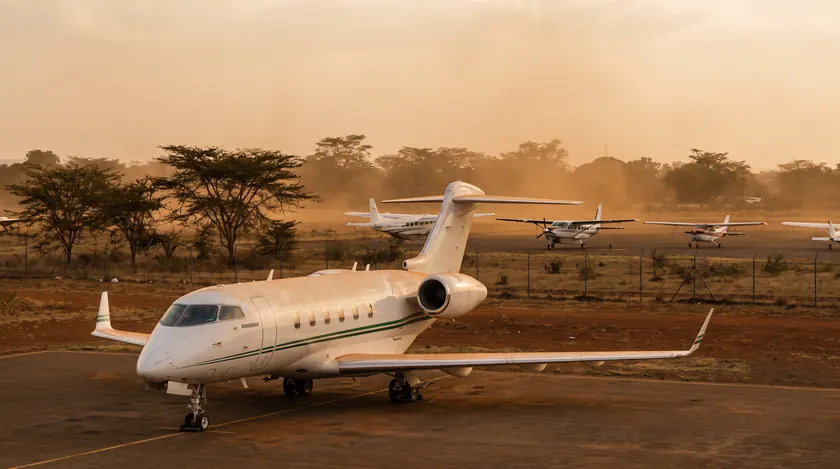
Clients ask me to price a jet before they've worked out whether they should own one at all. Some of them fly enough that ownership is the obvious answer. A lot of them would save money chartering and never notice the difference in comfort.
Here's how I actually walk a client through that decision, using real cost bands for the aircraft we sell most across Nigeria, Kenya, South Africa and Ghana, not a generic rule of thumb.
The comparison, side by side
Compare that against what's already listed on our private jets for sale pages before you assume ownership is out of reach. Some of the aircraft below cost less to buy than a year of heavy charter use would.
| Charter | Ownership | |
|---|---|---|
| Upfront cost | None | Purchase price, from around $1.8M for an older turboprop to $45M-plus for a Gulfstream G650 |
| What drives the cost | Per-flight charter rate plus repositioning | Fixed costs (hangar, insurance, crew) plus variable direct operating cost per hour |
| Typical Africa use case | Safari legs out of Nairobi, Accra-Dubai runs, ad hoc regional trips | Standing corporate routes like Lagos-Abuja or Johannesburg-Cape Town |
| Flexibility | Different aircraft each time, no maintenance to manage | Same tail, same crew, scheduling on your own terms |
| Where the risk sits | With the operator | With the owner: engine programs, service bulletins, resale value |
How many flight hours a year justifies buying a private jet instead of chartering?
There's no single published threshold, but our own cost models give a useful proxy. Owner-operated budgets we track assume roughly 200 to 400 hours a year for a Phenom 300E, 200 to 325 hours for a Pilatus PC-12, and around 450 hours for a Praetor 600. Below roughly 200 hours a year, the fixed costs of ownership, hangar, insurance, a retained crew, rarely get spread thin enough to beat charter. Above that, ownership usually starts winning.
Treat it as a rule of thumb, not a fixed line, and run these four numbers before you decide:
- Your realistic annual flight hours, not the optimistic number.
- The aircraft's direct operating cost per hour for the model you're actually considering.
- Fixed annual costs: hangar, insurance and crew retainer.
- What those same trips would cost on charter, hour for hour, including repositioning.
Is fractional jet ownership available in Africa?
Not in the way it's run in the US or Europe. We don't see an established, Africa-based fractional programme in our market data, most owners we deal with choose either full ownership or ad hoc and block charter rather than a fractional share. If you're looking at a fractional card sold by an international provider, confirm specifically whether it covers positioning flights to African airports. That's usually where the economics of an imported fractional programme break down fastest.
What is the average cost of a private jet charter in Kenya or South Africa?
We don't have a published, country-specific charter rate card for either market, and we'd be cautious of anyone who quotes you one without knowing the route and aircraft. Charter pricing is typically built off the aircraft's direct operating cost plus a margin and repositioning, so a Pilatus PC-12 safari charter out of Nairobi's Wilson Airport prices very differently from a Challenger 350 covering Johannesburg to Cape Town.
Message us with the route and the aircraft class you have in mind and we'll get you a live quote rather than a stale published number.
Prefer to just ask? Send a short message, we reply the same day.
Ask a questionWhat hidden costs come with owning a private jet?
These are the costs new owners underestimate most consistently:
- Engine program enrollment and the reserve it draws down between overhauls
- Avionics database currency and outstanding service bulletins
- Landing gear and brake overhaul cycles, tracked by time and cycles, not calendar age
- APU hours and maintenance
- Cabin refurbishment and interior condition as the aircraft ages
- Airframe corrosion inspection, especially at coastal or high-humidity African bases like Lagos or Accra
- Insurance and hangar, which accrue whether the aircraft flies or sits
Is chartering cheaper than owning for occasional flyers?
Generally, yes. The hours-per-year logic above holds up well in practice, and chartering also hands the resale risk and airworthiness-directive surprises entirely to the operator, which is part of what you're paying for. If you're an occasional flyer today but expect that to change, our guides on private jet operating costs in Africa and how to buy a pre-owned private jet, linked below, are the natural next stops once the hours start climbing.
Which one actually fits you
If your flying looks like Accra-Dubai a few times a quarter for a mining or energy business, jet charter in Ghana almost always beats owning outright. If it looks like a standing Lagos-Abuja shuttle every week, ownership starts making sense once the hours add up. Either way, jet charter in Kenya and safari-connection routes are a good test case: charter every trip for a year, track the real hours and cost, then revisit the ownership math with actual numbers instead of guesses.
Frequently asked questions
Does chartering ever make sense even for a very frequent flyer?
Sometimes, if the routes change constantly and no single aircraft fits every mission. A family that flies Lagos-London twice a year and Lagos-Abuja weekly may still be better off chartering the London legs on a larger aircraft while running a smaller owned jet for the shuttle work. It doesn't have to be all one or the other.
What's the single biggest cost people forget when comparing charter to ownership?
Repositioning. An owned aircraft based in Lagos still has to fly empty to collect you if you're starting from Abuja, and a chartered aircraft often bills that empty leg to reach you too. Both sides of the comparison need that cost included, not just the hours flown with passengers on board.
Do operating costs differ much between a midsize and a large-cabin jet?
Substantially. A Citation XLS+ runs roughly $3,000 to $3,800 an hour in direct operating cost, while a Gulfstream G450 runs closer to $6,072 an hour, more than double. The ownership math tips very differently depending on cabin class, so size the aircraft to the mission, not the aspiration.
Is a turboprop ever the better owned option over chartering a jet?
Yes, for short-field or utility missions where jets can't land anyway. A King Air 350i runs roughly $1,300 to $1,500 an hour and a Pilatus PC-12 around $2,000 to $2,425 an hour all-in, both well below jet-class costs, and both can use rough or unpaved strips common at African mining and safari sites.
Who carries the resale risk in each option?
In ownership, you do. The aircraft's value moves with the market between purchase and sale, and a thin logbook or overdue service-bulletin compliance can cut the price further than expected. Charter passes that risk entirely to the operator, which is part of what the charter rate is pricing in.
Want the numbers run for your own flying pattern
Give us your typical routes and rough annual hours, and we'll tell you honestly whether charter or ownership comes out ahead.
Ask a question