Buying in Kenya
Private Jets for Sale in Kenya
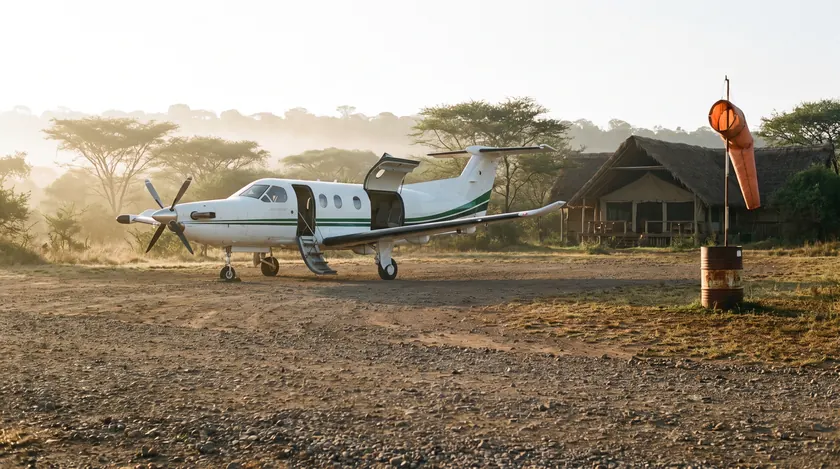
Nairobi is East Africa's private aviation capital, built around two very different airfields: Wilson, the low-rise general-aviation hub a mile from the CBD, and Jomo Kenyatta International, the country's main international gateway. Kenya is named, alongside South Africa and Nigeria, as one of the three markets leading Africa's fleet growth, and it has the local operator base, Phoenix Aviation, CMC Aviation, ALS, Safarilink, to show for it.
Buyers here split between corporate flight departments and safari-tourism operators, which is why turboprops sit right alongside jets in the same fleet lists. This page sets out realistic 2026 pricing by class, how a shilling quote works, what KCAA registration and Kenya's unusually favourable tax rules involve, and how we run a purchase from first message to delivery. Operators, airports and owners are profiled on our Kenya market overview.
Safari money meets corporate money
Wilson Airport (WIL) is where Kenya's general aviation and charter flying is concentrated, home to Phoenix Aviation and ALS, and it runs a 9pm-6am movement curfew for most GA traffic, worth knowing if you fly late. Jomo Kenyatta International (NBO) is the main international gateway, and in 2025 the airports authority was looking for a dedicated FBO operator there, a sign of how quickly private and charter traffic is growing. Mombasa's Moi International (MBA) covers the coast, with smaller-scale bizav infrastructure than Nairobi's two fields.
Nairobi-Johannesburg is the top regional business route out of Kenya, but the larger share of Kenyan charter flying is safari and lodge-access work into the Maasai Mara, Amboseli and the cross-border Tanzania circuit, mostly on turboprops like the Caravan and PC-12, with light jets for longer or higher-status trips. That split matters when you choose an aircraft: a jet built for long intercontinental range is the wrong tool for a Nairobi-Mara lodge run.
KCAA registration and Kenya's tax advantage
The Kenya Civil Aviation Authority (KCAA) registers Kenyan aircraft: each gets the 5Y- prefix followed by three letters of its own.
On paper, few African countries make importing a private jet cheaper. Kenya charges no import duty on aircraft, spare parts or jet fuel, and the 2023 Finance Act took VAT off aircraft purchases altogether, scrapping the Railway Development Levy and the Import Declaration Fee on aircraft at the same time. That puts Kenya well ahead of most neighbours on tax. Rules can still change, so check the current position with KCAA and KRA before you import rather than budgeting off a 2023 news story. Our registration requirements guide lines up KCAA's process against NCAA, SACAA and the other three authorities we track.
Private jet price in Kenya
Kenyan buyers usually ask the question in shillings, so here is how we answer it. The class ranges below use nothing but the model data on this site, indicative for 2026, and a given airframe lands higher or lower in its range depending on its hours, maintenance programmes and paperwork; the final number is confirmed per aircraft.
Most Kenyan fleets start with turboprops, which sit outside this table. A Pilatus PC-12 runs from about $1.8M for an early airframe to $8.15M for a new-generation NGX, and a King Air 350i from $4.1M to $7.4M; both are covered on their model pages. The first jet most buyers here move up to is the Embraer Phenom 300E. For lodge strips, the Pilatus PC-24 in the light row is certified for unpaved runways, which no other jet in our line-up is. Older aircraft set two floors: the Hawker 800XP, whose production ended in 2005, in midsize and the Legacy 600 in large cabin, while a current XLS+, Challenger 650 or Falcon 2000LXS costs far more.
Quotes in shillings. Aircraft change hands in US dollars. Ask for a shilling figure and the conversion uses that day's rate, dated on the quote, rather than a KES table that would drift within weeks.
Import on top. In Kenya this line is small, for the tax reasons set out above: no duty on aircraft imports and no VAT on aircraft purchases since 2023, subject to KRA confirming the current rules.
| Class | Typical Kenyan role | Models | USD range, indicative as of 2026 |
|---|---|---|---|
| Light jet | Nairobi-Johannesburg (1,560 nm), inside the published range of all three | Phenom 300E, PC-24 and CJ4 | roughly $5.3M to $13.5M |
| Midsize | Regional business legs with a stand-up cabin, such as Nairobi-Kigali (400 nm) or Addis Ababa (630 nm) | Hawker 800XP, Cessna Citation XLS+, Cessna Citation Latitude | $1.25M to $17M |
| Super-midsize | Nairobi-Dubai (1,930 nm) with range in hand | Bombardier Challenger 350, Gulfstream G280, Embraer Praetor 600 | $12M to $27M |
| Large cabin | London (3,690 nm) sits near the 4,000 nm range of the Challenger 650 and Falcon 2000LXS, so winds and payload decide | Legacy 600, Challenger 650, Falcon 2000LXS | $6M to $35M |
Prefer to just ask? Send a short message, we reply the same day.
Get options in KenyaHow we run a Kenyan purchase
- Tell us the mission (corporate travel, safari support, medevac or a mix), the budget and the timing on WhatsApp.
- Three to five airframes that suit that mission come back, with records to review.
- Choose one, and we take over the talks with the selling side on price and terms.
- Independent pre-purchase inspection, including a hard look at wing spar and wet-wing corrosion if it is a King Air.
- The KCAA registration and the 5Y- mark are filed alongside closing.
- Delivery, insurance confirmed, first flight from Wilson or JKIA.
Frequently asked questions
What is the private jet price in Kenya in shillings?
Our quotes are in US dollars, with a shilling equivalent calculated at that day's rate and dated. On the 2026 figures above, a light jet costs roughly $5.3 million to $13.5 million and a super-midsize $12 million to $27 million, while a PC-12 turboprop starts near $1.8 million. Because Kenya exempts aircraft imports from duty and, since 2023, VAT, the landed cost stays close to the price, subject to KRA confirming the current rules.
Can I register a private jet in Kenya as a foreign owner?
KCAA handles registration and issues the 5Y- mark with the aircraft's own three letters. We have not found a published foreign-ownership restriction in Kenya's guidance, so confirm your case directly with KCAA; arranging that check is part of our purchase work.
Is a private jet really duty-free and VAT-free in Kenya?
Yes, under the rules introduced by the Finance Act 2023: no import duty on aircraft, spare parts or jet fuel, no VAT on aircraft purchases, and no Railway Development Levy or Import Declaration Fee on aircraft imports. Few African jurisdictions are as favourable, but tax rules change, so check the current position with KCAA and KRA before you import.
What does the 5Y- prefix mean and how is a registration mark assigned?
5Y- is Kenya's nationality mark, applied to every aircraft on the Kenyan civil register. KCAA then assigns a three-letter registration mark specific to that aircraft, which together with the 5Y- prefix forms its full registration.
Should I base a Kenyan-registered jet at Wilson or JKIA?
Wilson Airport sits close to Nairobi's CBD and is the country's main general-aviation field, served by the Phoenix Aviation and ALS FBOs, but most GA movements stop between 9pm and 6am. JKIA is the international gateway and was seeking a dedicated FBO operator in 2025. Safari-support turboprops mostly live at Wilson; aircraft that fly more international legs often prefer JKIA.
Tell us what you actually fly
Corporate shuttle, safari support or both: name the mission and a budget in dollars or shillings, and we match the aircraft to it.
Get options in Kenya